What Is a GTIN, UPC, and EAN? A Complete Guide for Authors
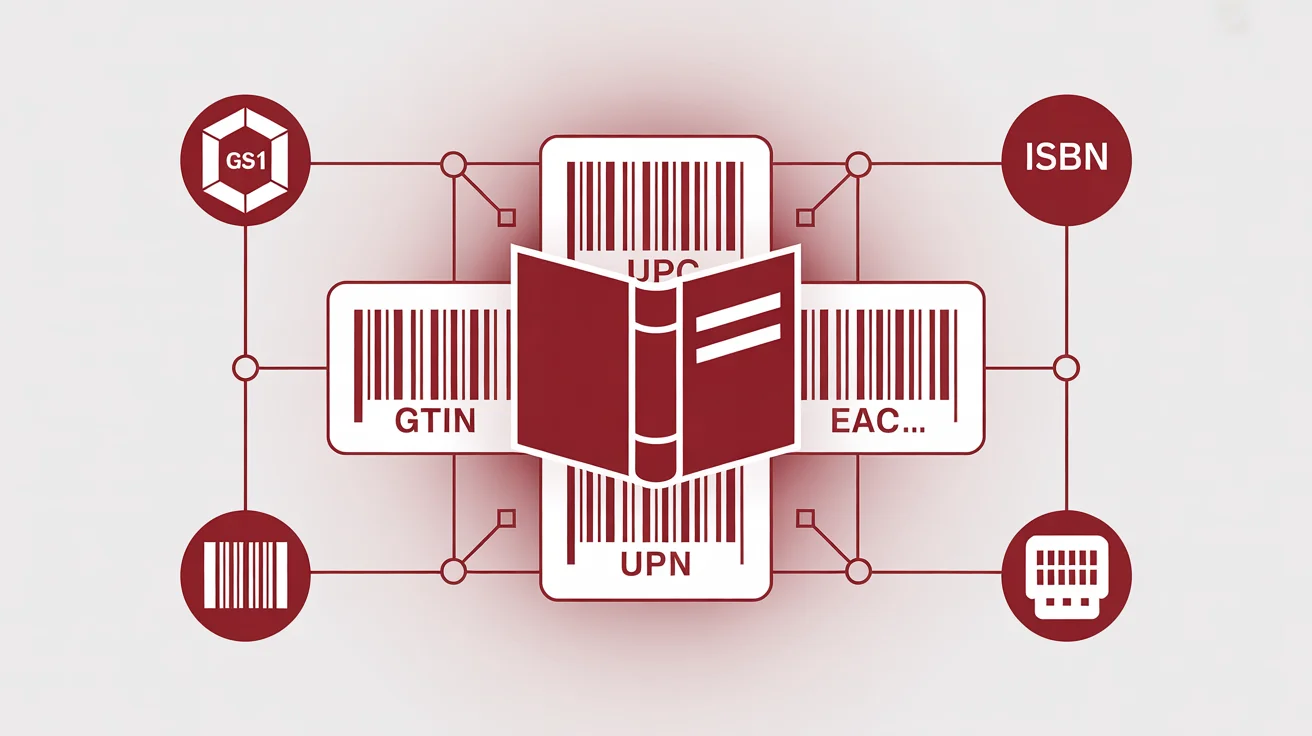
Understand the relationship between GTIN, UPC, EAN, and ISBN. This technical guide explains how these global product identification systems work and why authors should understand them.
If you have ever listed a product online, encountered retail inventory systems, or simply wondered what the numbers beneath a barcode represent, you have likely come across the terms GTIN, UPC, and EAN. For authors and publishers, understanding these identification systems is particularly valuable because the identifier (ISBN) assigned to a books is part of this same global framework.
This guide provides a technical overview of GTIN, UPC, and EAN, explains how they differ, and clarifies where ISBNs fit within this ecosystem.
What Is a GTIN?
GTIN stands for Global Trade Item Number. It is an umbrella term that encompasses all standardized product identification numbers used in global commerce. The GTIN system is developed and managed by GS1, a non-profit organization responsible for designing and implementing global standards for business communication.
A GTIN is not a barcode, it is the unique numerical identifier that can be encoded into a barcode for scanning purposes. The GTIN serves as a product’s “passport” in the global supply chain, enabling consistent identification across different systems, countries, and marketplaces.
GTIN Structure
All GTINs share a common structural framework consisting of three core components:
- GS1 Company Prefix: Assigned to the brand owner or manufacturer
- Item Reference: A unique number identifying the specific product
- Check Digit: A single digit calculated using a modulo-10 algorithm to verify the integrity of the number
GTIN Formats
GTINs come in four standardized lengths, each serving different use cases:
| Format | Digits | Common Use Case |
|---|---|---|
| GTIN-8 | 8 | Small products with limited packaging space |
| GTIN-12 | 12 | North American retail products (UPC) |
| GTIN-13 | 13 | International retail products (EAN), books (ISBN) |
| GTIN-14 | 14 | Wholesale packaging, cases, and shipping containers |
When a shorter GTIN needs to be stored in a 14-digit field, leading zeros are added. For example, a 12-digit UPC stored in a GTIN-14 field would have two leading zeros prepended.
What Is a UPC?
UPC stands for Universal Product Code. It is a 12-digit product identification number, technically classified as GTIN-12 within the GS1 system.
The UPC was introduced in the United States in 1974, making it one of the earliest barcode systems adopted for retail use. The first product scanned using a UPC barcode was a pack of Wrigley’s chewing gum at a supermarket in Ohio.
UPC Characteristics
- Digit Length: 12 digits
- Primary Region: United States and Canada
- Barcode Symbology: UPC-A (full 12 digits) or UPC-E (compressed 8-digit version)
- GTIN Classification: GTIN-12
UPC Structure
A standard UPC-A code consists of:
- Number System Digit (1 digit): Indicates the product category
- Manufacturer Code (5 digits): Identifies the brand owner
- Product Code (5 digits): Identifies the specific item
- Check Digit (1 digit): Validates the number
Although UPC originated in North America, it is recognized globally under GS1 standards. Retailers worldwide can scan and process UPC barcodes, provided their systems support the GTIN-12 format.
What Is an EAN?
EAN originally stood for European Article Number, though it is now officially known as the International Article Number while retaining the EAN abbreviation. The EAN is a 13-digit product identification number, classified as GTIN-13 in the GS1 system.
The EAN was developed in Europe to extend the UPC standard for international use. While UPC uses 12 digits, EAN uses 13 digits, with the additional digit providing a country or region prefix.
EAN Characteristics
- Digit Length: 13 digits (or 8 for EAN-8)
- Primary Region: Global (predominantly outside North America)
- Barcode Symbology: EAN-13 or EAN-8
- GTIN Classification: GTIN-13 or GTIN-8
EAN Structure
A standard EAN-13 code consists of:
- GS1 Prefix (2-3 digits): Indicates the numbering organization (often representing a country)
- Company Prefix (variable length): Identifies the brand owner
- Product Code (variable length): Identifies the specific item
- Check Digit (1 digit): Validates the number
The total length of the Company Prefix and Product Code always equals 9 or 10 digits, depending on the length of the GS1 Prefix.
For a deeper exploration of the EAN system and its relationship to ISBN, refer to our article on The EAN System.
GTIN vs. UPC vs. EAN
Understanding the relationship between these identifiers is essential. The following table summarizes the key differences:
| Attribute | GTIN | UPC | EAN |
|---|---|---|---|
| Full Name | Global Trade Item Number | Universal Product Code | International Article Number |
| Classification | Umbrella term | GTIN-12 | GTIN-13 (or GTIN-8) |
| Digit Length | 8, 12, 13, or 14 | 12 | 13 (or 8) |
| Geographic Origin | Global standard | North America | Europe (now global) |
| Year Introduced | 2005 (unified) | 1974 | 1977 |
| Managing Organization | GS1 | GS1 US | GS1 (international) |
The critical distinction is that GTIN is the concept, while UPC and EAN are specific implementations of that concept. When someone refers to a “GTIN,” they could be referring to any of the formats; UPC, EAN, or others. When they refer to a “UPC” or “EAN,” they are specifying a particular format within the GTIN family.
The 2005 Sunrise Initiative
Before 2005, North American retailers used UPC-A barcodes (12 digits), while the rest of the world used EAN-13 barcodes (13 digits). This created friction in international trade, as products had to be relabeled when crossing regions.
The 2005 Sunrise Initiative mandated that all North American retailers upgrade their point-of-sale systems to accept both 12-digit UPC and 13-digit EAN barcodes. This unification allowed products to move seamlessly across borders without relabeling, effectively merging the UPC and EAN systems under the GTIN umbrella.
How ISBN Fits Into the GTIN Family
For authors and publishers, the most relevant GTIN is the ISBN-13. The International Standard Book Number transitioned from a 10-digit format to a 13-digit format on January 1, 2007, specifically to align with the EAN-13 standard.
ISBN as a Specialized GTIN-13
An ISBN-13 is structurally identical to an EAN-13, with one distinguishing feature: the GS1 Prefix for books is either 978 or 979. These prefixes represent Bookland, a fictitious “country” created within the EAN system to accommodate the global book trade.
| ISBN-13 Component | Description |
|---|---|
| Prefix (978 or 979) | Bookland identifier |
| Registration Group | Language or geographic region |
| Registrant | Publisher identifier |
| Publication | Specific title and format |
| Check Digit | Validation digit |
For more information on the Bookland concept and how book barcodes function within the retail ecosystem, see Bookland: The Fictitious Country Where All Books Come From.
Practical Implication
Because ISBN-13 is a valid GTIN-13, books with ISBNs can be scanned and processed by any retail system that accepts EAN-13 barcodes. This is why the barcode on the back of a book functions identically to the barcode on any other retail product, they both encode a GTIN that the point-of-sale system can read.
For details on the structure and check digit calculation of 13-digit ISBNs, refer to The Anatomy of a 13-Digit ISBN.
When Authors Encounter GTIN, UPC, or EAN
Authors and publishers may encounter these terms in several contexts:
1. Online Marketplace Listings
Platforms such as Amazon, Walmart, and eBay require GTINs for product listings. For books, the ISBN serves this purpose. Amazon’s product catalog uses GTINs to prevent duplicate listings and verify product authenticity through the “Verified by GS1” system.
2. Retail Distribution
When a book is distributed to brick-and-mortar retailers, the ISBN barcode is scanned into inventory management systems. The ISBN functions as the GTIN, enabling the book to be tracked through the supply chain.
3. Non-Book Products
If an author sells merchandise, journals, or other products that do not qualify for an ISBN, they would need to obtain a UPC or EAN directly from GS1. Products that do not qualify for an ISBN are detailed in our ISBN Eligibility guide.
4. International Sales
Authors selling books internationally benefit from the ISBN-13 standard because it is recognized by retailers worldwide. The transition to ISBN-13 in 2007 ensured that book identification aligns with the global GTIN-13 (EAN) standard.
Barcodes vs. Identification Numbers
A common source of confusion is the distinction between the identification number and the barcode:
| Term | Definition |
|---|---|
| GTIN / UPC / EAN / ISBN | The numerical identifier assigned to a product |
| Barcode | The graphical representation of that number, encoded in a scannable format |
The barcode is merely a visual encoding of the underlying number. If you have the number (such as an ISBN), you can generate the barcode using freely available tools. There is no need to purchase a barcode separately from the number itself.
For a curated list of free barcode generation tools, see our Top 10 ISBN Barcode Generators.
Summary
The relationship between GTIN, UPC, EAN, and ISBN provides clarity on how products including books are identified in global commerce:
- GTIN is the umbrella term for globally standardized product identification numbers
- UPC (GTIN-12) is the 12-digit format originating in North America
- EAN (GTIN-13) is the 13-digit format used internationally
- ISBN-13 is a specialized EAN-13 with the Bookland prefix (978 or 979)
For authors, the ISBN serves as both the book’s unique identifier and its GTIN. This dual function allows books to integrate seamlessly into global retail systems, whether sold online, in bookstores, or through international distributors.
The standardization efforts of GS1 and the 2005/2007 transitions have created a unified system where a book published by an independent author has the same level of retail accessibility as one published by a multinational corporation. The barcode on your book speaks the same language as every other product on the shelf.

Araix Rand
Book Publicist
Araix has been helping authors with self-publishing and marketing their books. Additionally, he writes for various business and marketing blogs.
More posts by Araix Rand